

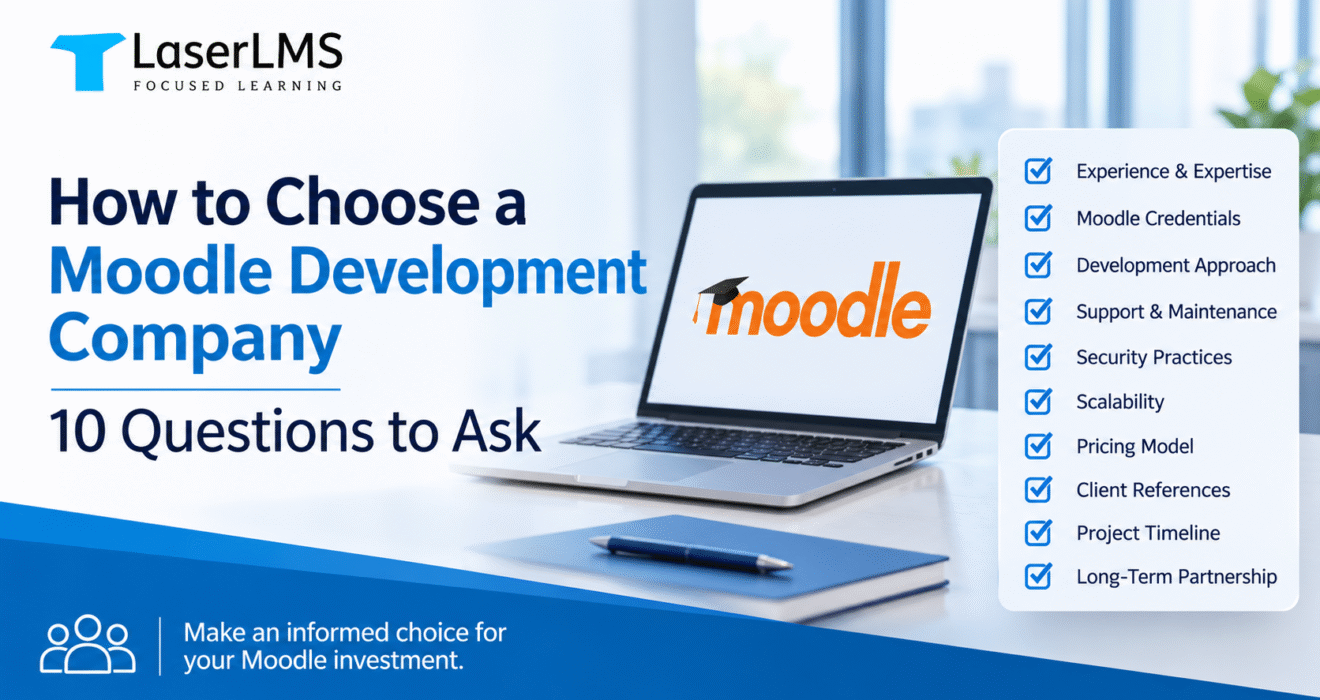
How to Choose a Moodle Development Company: 10 Questions to Ask
The right Moodle development company is the one that will still be looking after your platform three years from now, not the one with the slickest demo. Most Moodle projects that go wrong do so after launch: an upgrade breaks a custom feature, nobody knows how a plugin was built, or the agency has moved on.
Key takeaways
- Pick the company that will maintain your platform well after launch, not the best demo.
- Insist on no changes to Moodle core code, a tested upgrade process and full ownership of the source code.
- Ask every shortlisted company the same ten questions and compare the answers side by side.
- Enterprises should also check compliance evidence, recertification and a written SLA before signing.
We have built and supported Moodle platforms for more than 13 years, and we have inherited plenty of projects from other teams. These are the ten questions we would ask if we were in your seat, with what a good answer sounds like.
Table of Contents
Will you change Moodle core code?
The answer should be no. Everything custom should live in plugins, themes or configuration.
Core changes (“core hacks”) make every future upgrade a manual merge. They are the most common reason we see organisations stuck on an old, unsupported Moodle version. A good team will explain how they will build what you need as a plugin, or tell you honestly when Moodle cannot do it cleanly.
How do you handle Moodle upgrades?
Moodle ships two major releases a year, plus long-term support releases, and publishes the release and support dates in advance. Ask how they test an upgrade before it reaches your live site: a staging copy, a plugin compatibility check, a rollback plan.
A good answer names the steps. A vague answer (“we keep everything up to date”) usually means upgrades happen when something breaks. See our Moodle 5.x upgrade checklist for what a proper plan covers.
Which third-party plugins will you use, and why?
Plugins save money, but each one is a dependency. Ask for the list, and for each plugin: is it maintained, does it support current Moodle versions, and what happens if the author stops.
Good teams prefer well-maintained plugins from the Moodle plugins directory and keep the list short.
Who owns the code you write?
You should own the custom work, or at least have a perpetual right to use, change and move it. Moodle is GPL, and code that extends it generally falls under the GPL too, so you should receive the full source.
Get this in the contract. If you ever change supplier, the next team needs the code and the documentation, not a login to someone else’s server.
What does support look like after launch?
Ask what is included: security patches, minor upgrades, monitoring, backups, help for your admins. Ask about response times and who actually answers.
Many problems appear in the first three months, when real users arrive. A supplier that disappears after go-live is expensive, however cheap the build was.
Have you built integrations like ours?
Most corporate Moodle projects connect to something: single sign-on, an HR system, a CRM, an e-commerce store, a reporting tool. Ask for examples of the specific integration you need, and how they handle failures, such as a user who exists in one system and not the other.
How will reporting work?
Reporting is where L&D teams most often feel let down. Moodle’s standard reports cover a lot, but managers usually want completion and compliance views by team, location or client.
Ask them to sketch the three reports your managers will open every week, and how they will be built: standard reports, custom report builder reports, a plugin, or custom development.
Do you understand our type of training?
Compliance training, customer education, franchise training and university courses all use Moodle differently. Multi-client training companies often need multi-tenancy with IOMAD. Regulated industries need audit trails and recertification.
Ask for references from organisations like yours, and call them.
Where will it be hosted, and who is responsible?
Someone must own the server, backups, security updates and performance. Ask who that is, how often backups run, how restores are tested, and how the site will cope with your busiest day.
We compare the main options in Moodle hosting compared.
How do you price, and what is not included?
Fixed price, time and materials, or a monthly retainer can all work. What matters is that you know what is outside the quote: content migration, design, training your admins, and support after launch are the usual gaps.
A detailed estimate with assumptions listed is a good sign. A single number on one page is not. Our guide to Moodle development cost explains what drives the price.
If you are an enterprise
Large organisations need everything above, plus three things that smaller projects can often skip. Ask about them directly, because they are where enterprise Moodle projects most often go wrong.
Compliance
In regulated industries, your training records are evidence. An auditor may ask who completed which course, which version of it, when, and with what score, sometimes years later.
Ask the company:
- How completion records, grades and certificates are kept and backed up, and for how long.
- How you will export evidence for an audit without a developer’s help.
- Where data is hosted and processed, and how they meet data protection rules such as GDPR that apply to you.
- How they handle accessibility, since public bodies and many large employers must meet WCAG standards.
A good answer includes how they have handled an audit for another client.
Recertification
Compliance training is rarely one and done. Safety, privacy and clinical courses often expire every 12 or 24 months, and learners must retake them.
Standard Moodle does not handle recertification on its own. It is usually done with a plugin such as Course Recompletion, with IOMAD licences that expire, or with the certifications feature in Moodle Workplace. Ask which approach they recommend for you, and how they keep the history of earlier completions when a learner retakes a course. Losing last year’s record when this year’s attempt starts is a common and costly mistake.
Service level agreement (SLA)
When the platform is down the week before an audit deadline, “we will look into it” is not good enough. An enterprise contract should define:
| SLA item | What to agree |
|---|---|
| Severity levels | What counts as critical, high, medium and low |
| Response time | How fast someone acknowledges the issue, per severity |
| Resolution target | How fast it is fixed or worked around, per severity |
| Support hours | Which hours and time zones are covered, and who covers weekends |
| Uptime | The target, how it is measured, and what happens if it is missed |
| Maintenance windows | When planned updates happen and how much notice you get |
| Escalation | Named contacts and the path when an issue is not moving |
| Reporting | A monthly summary of incidents, uptime and changes |
Ask for a sample SLA before you sign, and check it covers the parts you actually depend on: hosting, integrations and custom plugins, not only Moodle itself.
Red flags
- They plan to change core Moodle code.
- They cannot tell you which Moodle version they will build on, or when you will next upgrade.
- No staging site.
- You will not receive the source code.
- Every question is answered with “yes, Moodle can do that”.
A short checklist for your shortlist
| Question | Good sign |
|---|---|
| Core changes | None, everything in plugins |
| Upgrades | Staging, tested plan, rollback |
| Plugins | Short list, maintained, justified |
| Code ownership | In the contract, full source handed over |
| Support | Defined scope and response times |
| Integrations | Similar examples, failure handling explained |
| Reporting | Reports sketched before the build |
| References | Organisations like yours |
| Hosting | Clear owner, tested restores |
| Pricing | Assumptions and exclusions listed |
Take the same questions to every company on your shortlist. The differences in their answers will tell you more than any proposal.
Frequently asked questions
Planning a Moodle project?
JustAddWater has built and supported Moodle and IOMAD platforms for training companies and enterprises for over 13 years. Tell us about your learners and what your current platform cannot do, and we will come back with a straight answer on cost, timeline and fit.
About the author: Himanshu Saini
Founder of JustAddWater and Moodle LMS architect. 13+ years building and supporting Moodle, IOMAD and WordPress learning platforms.
