

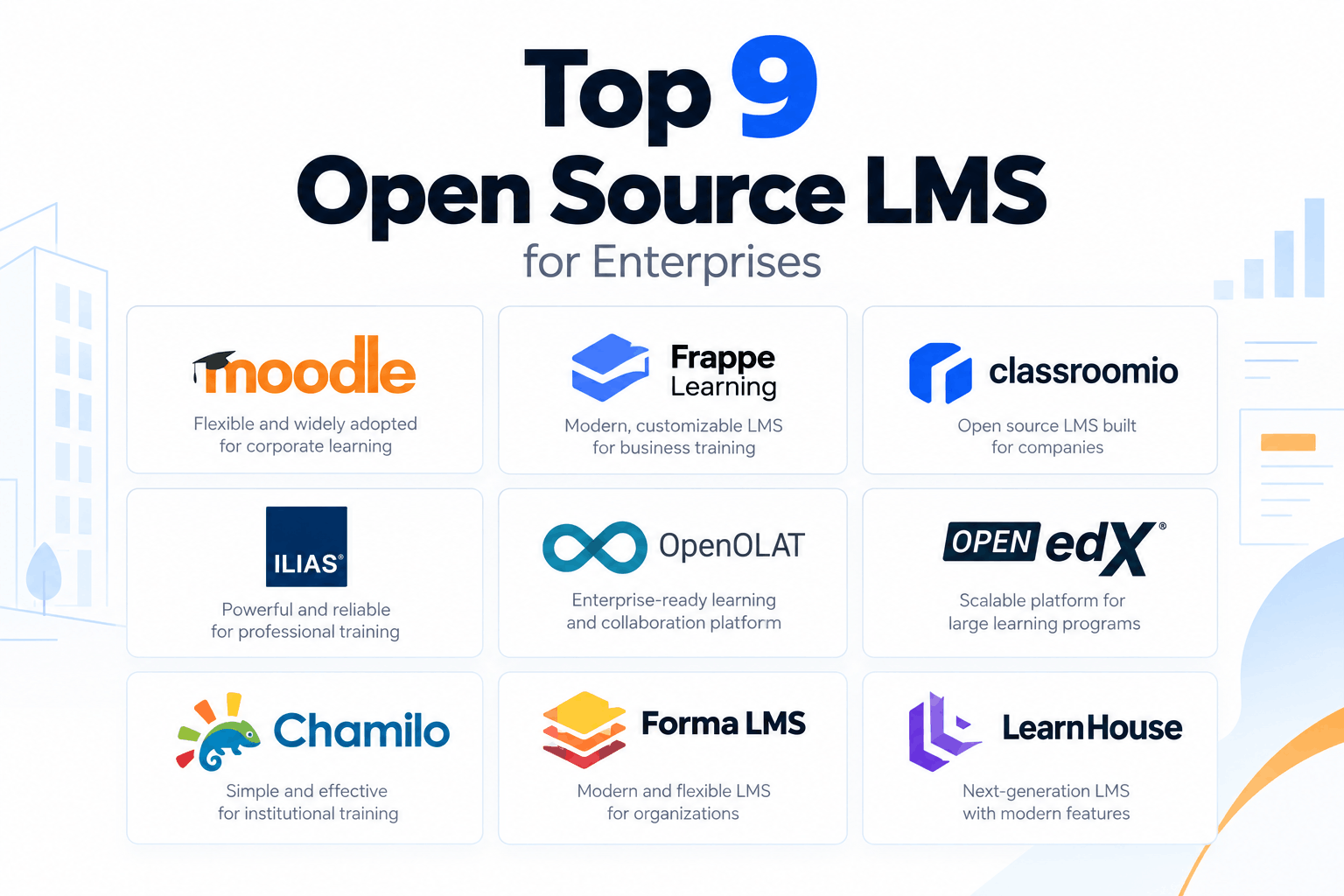
Top 9 Open-Source LMS for Corporate Training and Compliance (2026)
The best open-source LMS for corporate compliance in 2026 is Moodle for most organisations, ILIAS for regulated environments, and Forma LMS or Chamilo for teams that want a lighter, corporate-first platform. This guide ranks 9 platforms on how well they handle employee compliance, not academic teaching.
Compliance training is more than course delivery. A compliance-ready LMS has to assign training by role or department, track completion, issue certificates, expire and renew them on schedule, and produce an audit report that holds up for any past date. Many good LMS platforms do some of this. Few do all of it without extra work.
Who this is for: L&D, HR and IT teams choosing a self-hosted LMS for mandatory training (safety, data protection, anti-bribery, code of conduct, industry certification), and companies building a training product on an open-source core.
Table of Contents
At a glance
Only four of the nine handle certificate expiry and renewal out of the box: Forma LMS, Chamilo, OpenOlat and ClassroomIO. Moodle gets there with IOMAD or plugins.
| # | Platform | Best for | Licence | Certificate expiry and renewal | SCORM | Multi-tenancy |
|---|---|---|---|---|---|---|
| 1 | Moodle | Most organisations | GPL-3.0 | Via IOMAD, plugins or Workplace | 1.2 native, 2004 partial | IOMAD (open source) or Workplace (commercial) |
| 2 | ILIAS | Regulated, permission-heavy environments | GPL-3.0 | Study programmes with validity periods | 1.2 and 2004, certified | Org units, single tenant |
| 3 | Forma LMS | Corporate-first training | GPL | Native certifications with expiry | 1.2, 2004, AICC | Multi-client admin areas |
| 4 | Chamilo | Lighter corporate LMS | GPL-3.0+ | Native certificate expiry | 1.2, 2004 partial | Hierarchical multi-URL |
| 5 | OpenOlat | Certification bodies, Java teams | Apache-2.0 | Native recertification programmes | 1.2 and 2004 | Single tenant |
| 6 | ClassroomIO | Compliance-first, modern stack | AGPL-3.0 | Native renewals, grace periods, waivers | Not listed | Multi-org |
| 7 | Frappe Learning | Companies on ERPNext or Frappe HR | AGPL-3.0 | Build it yourself | Basic upload | Framework multi-site |
| 8 | Open edX | Large academies, workforce upskilling | AGPL-3.0 | Limited | 1.2 and 2004 via XBlock | Multi-site |
| 9 | LearnHouse | API-first custom builds | AGPL-3.0 + Enterprise | Not native | Enterprise licence | Enterprise licence |
How we evaluated
We ranked each platform on how much of the compliance lifecycle it covers without custom development, then on ecosystem maturity and running cost.
- Assignment: can training be assigned automatically by department, role, location or manager?
- Recurrence: can certificates expire and trigger renewal without duplicate enrolments?
- Evidence: can you produce an audit report showing who was compliant on a past date?
- Standards: SCORM 1.2 and 2004, xAPI and cmi5, so existing course libraries keep working.
- Organisation fit: hierarchy, multi-tenancy, SSO (SAML or OIDC) and an HR data feed.
- Sustainability: release activity, governance, licence terms and availability of developers.
Every platform here is free to download. Your real cost is hosting, configuration, custom development and upgrades.
1. Moodle
Moodle is the safest default: the largest ecosystem, the most integrations and the widest pool of developers. It is not compliance-ready on its own, but it has more ways to get there than any other platform on this list.
- Best for: organisations that want a proven platform and expect to customise it.
- Licence and stack: GPL-3.0; PHP with MySQL, MariaDB, PostgreSQL or SQL Server. Current releases are the 5.x series.
- Compliance features: enrolment rules, completion tracking, competencies, learning plans and a report builder in core. Certificates with expiry and recertification come from plugins, IOMAD or the commercial Moodle Workplace.
- Multi-tenancy: two routes. IOMAD is a free, open-source Moodle distribution that adds tenants, per-tenant branding and SSO, company hierarchies, licence-based enrolment and compliance reports. Moodle Workplace is the commercial alternative sold through Moodle partners.
- Standards: SCORM 1.2 native (2004 partially), LTI 1.3 Advantage, REST web services. Core Moodle has an xAPI API for plugins, but full xAPI content tracking needs a plugin and an external LRS.
- AI: since 4.5, a built-in AI subsystem connects to providers such as OpenAI, Azure and Ollama, with admin controls on who can use it.
- Limitations: complex to configure well; the default UI needs theming for a modern corporate feel; plugin quality varies and can complicate upgrades.
- Hosting effort: medium. Standard LAMP hosting, but plan for staging, upgrades and plugin testing.
2. ILIAS
ILIAS is the strongest choice when access control and standards compliance matter more than ecosystem size. It is widely used by public-sector and regulated organisations in German-speaking Europe.
- Best for: regulated industries, public sector, and organisations with complex permission models.
- Licence and stack: GPL-3.0; PHP. Governed by the ILIAS Society, a non-profit with institutional members and certified service providers. ILIAS 11.4 shipped in September 2026.
- Compliance features: very granular role and permission system, organisational units, strong test and assessment engine, learning progress tracking, certificates, and study programmes that can set how long a qualification stays valid.
- Standards: SCORM 1.2 and SCORM 2004 3rd Edition, both certified, plus AICC, IMS QTI and LTI. It also has a native xAPI/cmi5 object, which needs an external Learning Record Store.
- Multi-tenancy: organisational units handle structure within one organisation; true multi-tenant SaaS is not its design.
- Limitations: smaller global developer community than Moodle; the interface feels institutional rather than consumer-modern; less familiar to PHP developers outside Europe.
- Hosting effort: medium. Self-hosted PHP, with professional service providers available.
3. Forma LMS
Forma LMS is the most purpose-built corporate LMS on this list. It started as a community fork of the open-source Docebo codebase, and it has kept that corporate focus.
- Best for: internal employee training, certification bodies and training companies serving several client organisations.
- Licence and stack: GPL; PHP with MySQL or MariaDB. Maintained by forma.association; version 4.2 shipped in July 2026.
- Compliance features: certifications with expiry dates, classroom training records and audit-oriented reporting, plus a custom report builder with scheduled email delivery.
- Standards: SCORM 1.2 and 2004, AICC and xAPI (Tin Can) packages.
- Multi-tenancy: multi-client setups with branded admin areas and organisation hierarchies are part of the core positioning.
- Limitations: a much smaller community than Moodle; the admin interface feels dated; documentation is thinner; some distribution and support options are tied to association membership.
- Hosting effort: medium. Standard PHP hosting, but many companies budget for a support contract.
4. Chamilo
Chamilo packs more compliance features into a lighter platform than any other PHP option here. Version 3, rebuilt on Symfony and Vue, makes it a serious modern alternative to Moodle.
- Best for: mid-sized companies that want a simpler admin experience with real compliance features.
- Licence and stack: GPL-3.0+; PHP 8.3+ on Symfony, with Vue and Tailwind on the front end, and MariaDB or MySQL. Chamilo 3.0.1 shipped on 19 September 2026.
- Compliance features: skills management, certificate expiry dates, auditing, sessions, attendance tracking and learning analytics.
- Standards: SCORM 1.2, partial SCORM 2004, QTI, LTI, xAPI and cmi5, plus a JWT-secured API.
- Multi-tenancy: hierarchical multi-URL setup, so one installation can serve several portals.
- Limitations: smaller ecosystem than Moodle; governance moved to BeezNest in 2026 after the Chamilo Association dissolved; version 3 is new and less proven at large scale.
- Hosting effort: low to medium. A conventional PHP stack with modest requirements.
5. OpenOlat
OpenOlat now has one of the most complete recertification systems of any open-source LMS. Its 20.2 release added certificate programmes with validity rules, automatic or manual renewal, credit points, and notifications for expiry and recertification.
- Best for: certification bodies, professional associations and organisations with Java expertise.
- Licence and stack: Apache-2.0; Java. Developed by frentix GmbH in Switzerland, with a lineage going back to the University of Zurich in 1999.
- Compliance features: certificate programmes with expiry, transition periods and renewal; a central view of who is certified, in progress or lapsed; coaching tools and strong assessments.
- Standards: SCORM 1.2 and 2004, IMS QTI 2.1 and LTI 1.3. xAPI is not a core strength.
- Multi-tenancy: built for one organisation; serving many client companies needs extra design work.
- Limitations: development is led by one vendor rather than a broad community; far fewer plugins than Moodle; Java hosting is heavier for teams used to PHP.
- Hosting effort: medium to high, unless you buy hosting and support from frentix.
6. ClassroomIO
ClassroomIO is the only platform here designed around compliance from day one. The trade-off is maturity: it is young, and its standards support is thin.
- Best for: companies that want a modern, lightweight compliance tool and do not depend on a large SCORM library.
- Licence and stack: AGPL-3.0; TypeScript with SvelteKit, Hono, PostgreSQL and Redis, deployed with Docker. SSO and token authentication need a paid licence key when self-hosted.
- Compliance features: deadline tracking, renewals and retake intervals, grace periods, waivers, compliance status and branded certificates with custom IDs.
- Integrations: REST API and webhooks (for events such as certificate issued or enrolment completed), an embeddable course widget, and an MCP server for AI tools. The AI course builder supports OpenAI and Gemini models.
- Standards: SCORM and xAPI are not listed as features. Test your existing content before committing.
- Multi-tenancy: multiple organisations and teachers on one instance.
- Limitations: small community and short track record; limited public evidence of large enterprise deployments; AGPL obligations apply if you modify it and offer it as a service.
- Hosting effort: low. A single Docker-based setup script.
7. Frappe Learning
Frappe Learning is the natural choice if your company already runs ERPNext or Frappe HR, because learning data can live alongside employee records. As a standalone compliance LMS, it is still immature.
- Best for: companies on the Frappe ecosystem, or teams building a custom learning product on a business-application framework.
- Licence and stack: AGPL-3.0; Python on the Frappe Framework, with a Vue front end and MariaDB. Very active, with v2.63.0 released on 10 September 2026.
- Compliance features: courses, batches, quizzes, assignments, certificates, completion enforcement and quiz proctoring. Expiry and recertification are not built in, but the framework makes them straightforward to build with DocTypes, workflows and scheduled jobs.
- Standards: SCORM packages can be added as chapters; a lesson is marked complete when the package reports a passed status. Detailed SCORM tracking and xAPI are not supported.
- Multi-tenancy: provided by the Frappe Framework’s multi-site setup.
- Limitations: the LMS feature set is young; sophisticated compliance rules mean writing and owning your own code.
- Hosting effort: low to medium. Docker, the Frappe bench installer, or managed hosting on Frappe Cloud.
8. Open edX
Open edX is built for learning at massive scale, not for routine employee compliance. It earns its place when the goal is a large customer academy or a workforce upskilling programme.
- Best for: large academies, customer education and upskilling programmes with thousands of concurrent learners.
- Licence and stack: AGPL-3.0 for the core platform; Python and Django, React front ends, MySQL, MongoDB, Redis and Celery. Stewarded by the non-profit Axim Collaborative, with named releases every six months.
- Compliance features: strong assessments, certificates, grading and analytics. Recurring assignment and certificate expiry are not native and need custom services.
- Standards: LTI Advantage Complete certification as of the Ulmo release. SCORM 1.2 and 2004 run through the community SCORM XBlock rather than natively.
- Multi-tenancy: multi-site configuration is possible but adds operational work.
- Limitations: heavy infrastructure; needs strong DevOps skills; more platform than most compliance programmes need.
- Hosting effort: high. Usually deployed with the Tutor toolkit on Docker or Kubernetes, and many teams choose a managed provider.
9. LearnHouse
LearnHouse has the most modern authoring experience on this list, but several features a compliance programme needs sit behind a separate commercial licence. Read the licence terms before you build on it.
- Best for: teams building a custom, API-first learning product who want a strong content editor.
- Licence and stack: AGPL-3.0 core, with enterprise features under a separate licence; Python (FastAPI) back end, Next.js and React front end, PostgreSQL and Redis.
- Compliance features: courses, assignments, user groups, analytics and automatic certificates on completion. No native expiry or recertification.
- Enterprise-licence features: SSO, multi-organisation hosting and payments, plus SCORM and audit logs according to the project’s enterprise materials.
- Standards: REST API; SCORM only in the enterprise tier.
- Extras: a Notion-style block editor, AI assistance, real-time collaborative whiteboards and code exercises with auto-grading.
- Limitations: young ecosystem; compliance is not the project’s focus; key corporate features are not in the open-source core.
- Hosting effort: low. An official CLI handles setup, updates and backups.
Why these didn’t make the list
- Canvas LMS: excellent open-source LMS (AGPL-3.0, Ruby on Rails), but built for schools and universities. Compliance lifecycle features need custom work, and self-hosting it is demanding.
- Sakai: mature and genuinely open (Apereo Foundation), but its focus and community are academic.
- Claroline Connect: a modern Symfony and React stack, but with thin compliance features out of the box.
- Totara: a Moodle-derived corporate LMS with strong compliance features, but commercially licensed, so it is not open source.
- LearnDash and other WordPress LMS plugins: useful for selling courses, but they are plugins rather than standalone LMS platforms, and compliance reporting is limited.
- ATutor and Dokeos: ATutor is no longer supported; Dokeos is now a commercial product.
How to choose
Pick your shortlist by situation, then prove it with a two-week test on your own data.
- You want the safest long-term bet: Moodle, adding IOMAD if you serve several companies or business units.
- You are in a regulated or public-sector environment: ILIAS.
- You want corporate features without Moodle’s complexity: Forma LMS or Chamilo.
- Recertification is your core problem: OpenOlat, Forma LMS or ClassroomIO.
- You already run ERPNext or Frappe HR: Frappe Learning.
- You are building an academy for thousands of external learners: Open edX.
Test these before you commit
- Import a realistic user base (thousands of employees with departments, roles and managers).
- Run a full annual cycle: assignment, completion, certificate, expiry, renewal.
- Check that recurring assignments never create duplicate enrolments.
- Upload your real SCORM 1.2 and 2004 packages and compare the tracking data.
- Connect SSO and your HR feed, then test joiners, movers and leavers.
- Produce an audit report showing who was compliant on a past date.
- Run an upgrade with your customisations installed.
- Estimate how much must be built versus configured.
FAQ
Last reviewed: 26 September 2026. Licences, versions and features change; check each project’s official site before deciding.
