

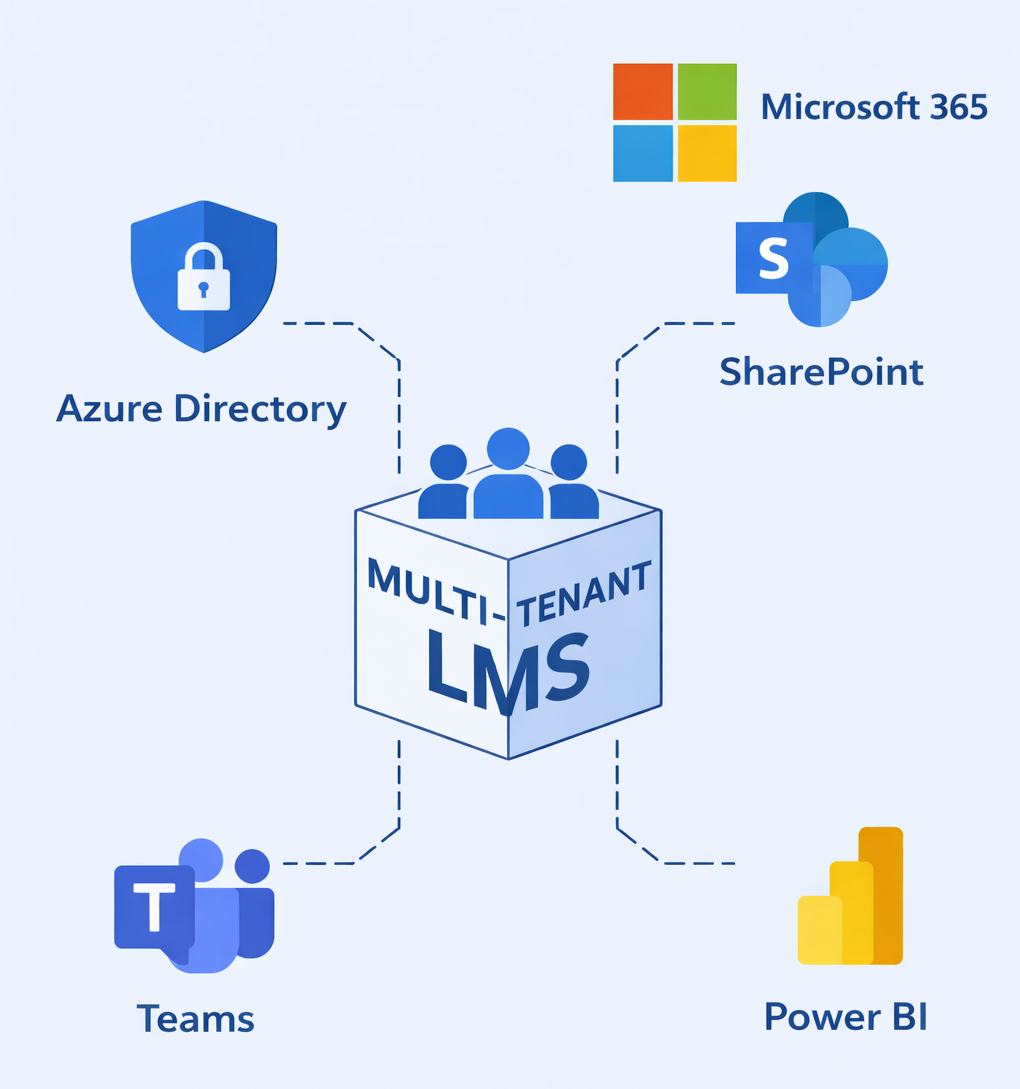
Best Multi-Tenant LMS Platforms for 2027
How ten multi-tenant learning platforms separate tenants, what they cost, where they fall short, and when owning the platform is cheaper.
The short answer
There is no single best multi-tenant LMS. The right one depends on how many separate audiences you train, how independent each must be, and whether you want to rent the platform or own it.
| If you are | Start with |
|---|---|
| A large enterprise training customers and partners, with budget | Docebo |
| A mid-size company that wants many branded portals quickly | LearnUpon |
| A small team with up to 15 separate audiences | TalentLMS |
| A training company that sells to client organisations | Academy of Mine |
| An organisation with strict compliance reporting | Absorb LMS or Totara |
| An organisation that wants open source with vendor backing | Moodle Workplace or Open LMS |
| A team with developers that wants no licence fee | IOMAD |
| An organisation whose LMS must fit its own systems and rules | A platform you own, built on open source |
The rest of this guide explains how each option separates tenants, what it costs, and where it stops.
What's in this article
What does multi-tenant mean for an LMS?
A multi-tenant LMS is one installation that serves several separate groups, called tenants. Each tenant has its own users, courses, branding and administrators, and cannot see the others.
Vendors use the word for three different things, and the difference matters when you buy.
| Level | What you get | Typical names |
|---|---|---|
| Branded areas | A separate look and address on shared settings | Branches, sub-portals, domains |
| Logical tenants | Separate users, admins, roles and reports in one database | Tenants, companies |
| Separate instances | A full copy of the platform per tenant | Sites, instances |
Who needs it
- Companies that train customers, partners or resellers as well as staff
- Training providers that deliver courses to many client organisations
- Groups with several brands, regions or franchises
- Associations that run learning for member organisations
Five questions to ask every vendor
- What can a tenant administrator do without calling the main administrator?
- Can each tenant have its own sign-in method, such as Microsoft 365 for one and passwords for another?
- Is tenant data separated logically or physically, and does that meet your compliance rules?
- Does the price change with the number of tenants, the number of users, or both?
- Can one course be shared with several tenants and updated in one place?
Multi-tenant LMS platforms compared
Most vendors do not publish prices. Where a figure comes from buyer data or a third-party estimate, the table says so.
| Platform | How tenants are separated | Price signal | Best for |
|---|---|---|---|
| Docebo | A client per branch, each with its own address, branding, sign-in and catalog | Median contract of $42,019 a year across 147 purchases | Large enterprise customer and partner training |
| LearnUpon | Portals with their own branding, users and content | Not published. Estimates of $6 to $9 per user per month | Mid-size companies with many portals |
| Absorb LMS | Departments inside one shared portal | Not published. Median contract of about $20,000 a year across 51 purchases | Compliance-heavy organisations |
| TalentLMS | Branches: 1 on Core, 3 on Grow, 15 on Pro, unlimited on Enterprise | From $119 a month | Small teams |
| Academy of Mine | Unlimited B2B group portals | $999 a month flat on Professional | Training companies selling to client organisations |
| Moodle Workplace | Logical tenants with their own users, roles, themes and reports | Through partners only. One UK partner lists £6,000 per unit per year | Open source with vendor backing |
| Totara | Tenants with optional isolation, tenant managers and tenant themes | Subscription by active users, sold through partners. Not published | Complex organisations and compliance |
| Open LMS | Multitenancy on the Corporate plan | Per active user. Not published | Teams that know Moodle and want it managed |
| Opigno Enterprise | Several branded environments run from one admin hub | From $6 per user per month | Teams that want AI-led personalised training |
| IOMAD | Companies inside one Moodle installation, with their own branding and hierarchy | No licence fee. You pay for hosting and skills | Teams with Moodle developers |
Contract figures for Docebo and Absorb are from Vendr's buyer data and a summary of Vendr and SpendHound data. The LearnUpon estimate is from a third-party pricing review. The Moodle Workplace figure is from a UK government marketplace listing.
The platforms in detail
1. Docebo
Best for large enterprise customer and partner training
How tenancy works
The Extended Enterprise app gives each branch a client with its own address, branding, catalog, languages and payment settings. Sign-in methods such as SAML and OpenID Connect can be set per domain.
Price
Not published. Buyer data shows a median contract of $42,019 a year, ranging from about $21,000 to $111,000.
Watch for
One client per branch, and super administrators see every tenant. Docebo says the app is not suited to giving each branch its own independent super administrator.
Choose it if
You have the budget and want AI features, e-commerce and broad integrations in one product.
2. LearnUpon
Best for mid-size companies with many portals
How tenancy works
Each portal has its own branding, users, content and address. Courses can be shared across portals, updated from the top portal, or licensed to a portal for a set number of enrolments.
Price
Not published. Third-party estimates put it at $6 to $9 per active user per month.
Watch for
Per-user pricing grows with every tenant you add. There is no built-in content library.
Choose it if
You want portals set up in minutes and strong support. One customer runs more than 800 portals.
3. Absorb LMS
Best for compliance-heavy organisations
How tenancy works
Tenants are departments inside one shared portal. Each department can have its own admins, user management, branding on messages and landing page.
Price
Not published. Buyer data shows a median contract of about $20,000 a year, and enterprise deals average far more.
Watch for
Several settings can only be set once per portal, including virtual meeting integrations, analytics and email sending. Tenants that need those separately need separate portals.
Choose it if
Reporting and compliance tracking matter more than tenant independence.
4. TalentLMS
Best for small teams
How tenancy works
Branches act as sub-portals with their own users, courses and branding.
Price
From $119 a month. Core includes 1 branch, Grow 3, Pro 15 and Enterprise unlimited.
Watch for
The branch limits. A provider with 20 client organisations is on Enterprise pricing from the start.
Choose it if
You have a handful of audiences and want to be live this week.
5. Academy of Mine
Best for training companies
How tenancy works
Unlimited B2B group portals for client organisations, with e-commerce, single sign-on and a custom domain.
Price
$999 a month flat on Professional. Enterprise is quoted and aimed at 1,000 or more monthly active users.
Watch for
The starting price is high for a small provider.
Choose it if
You sell courses to companies and want a flat fee instead of a per-user bill.
6. Moodle Workplace
Best for open source with vendor backing
How tenancy works
Each tenant has its own users, hierarchy, roles, theme, reports and delegated administrators. Tenants cannot see each other's personal data by default.
Price
Available only through Moodle Certified Partners, who set their own prices. One UK partner lists £6,000 per unit per year.
Watch for
Tenant data sits in the same database, a user belongs to one tenant only, and physical separation is not supported.
Choose it if
You want Moodle's ecosystem with an official multi-tenant product and a partner to run it.
7. Totara
Best for complex organisations
How tenancy works
Each tenant gets its own category, audience, managers and theme, including its own sign-in page. Isolation is optional and has been a standard feature since Totara 18.
Price
The core is open source, but production use normally means a subscription priced by active users and a partner contract. Prices are not published.
Watch for
Sign-in methods, tags and plugin settings are system-wide and cannot be limited to one tenant. Turning isolation on removes some performance features.
Choose it if
You need learning, performance and compliance in one platform with real tenant separation.
8. Open LMS
Best managed Moodle option
How tenancy works
Multitenancy is part of the Corporate plan on a hosted, Moodle-based platform.
Price
Per active user, by quote.
Watch for
Deep customisation still needs development work.
Choose it if
Your team knows Moodle and wants hosting and updates handled.
9. Opigno Enterprise
Best for AI-led personalised training
How tenancy works
Several custom-branded environments run from one admin hub.
Price
Listed from $6 per user per month across three tiers.
Watch for
A small review base, so ask for references in your sector.
Choose it if
You want role-based personalisation and integration with HR and CRM systems.
10. IOMAD
Best free multi-tenant build on Moodle
How tenancy works
Each company gets an isolated area in one Moodle installation, with its own branding, hierarchy, reports and course sales.
Price
No licence fee. Your costs are hosting and the people who run it.
Watch for
It needs experienced Moodle administrators, and you should check which Moodle version the current release supports.
Choose it if
You have developers, or a partner, and want to own the platform outright.
What does a multi-tenant LMS cost as tenants grow?
The pricing model matters more than the starting price, because each model reacts differently when you add tenants.
| Pricing model | What happens when you add a tenant | Platforms |
|---|---|---|
| Per active user | Cost rises with every learner the tenant brings | LearnUpon, Docebo, Open LMS, Totara, Opigno Enterprise |
| Plan with a tenant cap | Cost jumps when you pass the cap | TalentLMS |
| Flat fee | Cost stays level until you reach the plan's ceiling | Academy of Mine |
| Owned platform | Cost stays close to level, since you pay for hosting and support | IOMAD, a custom build |
A worked example: 10 client organisations with 200 learners each
| Option | Rough yearly cost | How it is worked out |
|---|---|---|
| LearnUpon | $144,000 to $216,000 | 2,000 users at an estimated $6 to $9 per user per month |
| Docebo | $42,019 median contract | Buyer data across all sizes, so a 2,000-user quote may differ |
| TalentLMS | Enterprise quote | Pro allows 15 branches but charges $6 for each user above its limit |
| Academy of Mine | $11,988 or an Enterprise quote | $999 a month on Professional. Enterprise is aimed at 1,000 or more monthly active users |
| Owned platform with managed hosting | $4,800 to $10,800 after a one-time build | Managed plans from $400 to $900 a month |
These are estimates built from public figures. Ask each vendor for a quote at your own numbers.
Should you buy a product or own the platform?
A SaaS product is the better choice more often than vendors of custom work admit. Owning the platform pays off in a specific set of situations.
| Buy a SaaS product when | Own the platform when |
|---|---|
| You have a few tenants and under about 500 learners | You have many tenants, or learner numbers that make per-user pricing painful |
| Standard features cover what you need | Tenants need their own sign-in methods, rules or workflows |
| You have no technical team and want none | The LMS must sync with your HR, identity or business systems |
| You need to be live this month | Your data has to stay in a region or environment you control |
| You want a built-in content library | You want to add features without waiting on a vendor's roadmap |
An example: a Canadian pharmacy network
A Canadian pharmacy network needed one LMS for its own staff and for selected customers. Its requirements were specific:
- Each customer has a separate section with its own administrators, who manage only their own users.
- Staff sign in with Microsoft 365, and external users sign in with a username and password.
- Company administrators cannot see or manage external users.
- Training is assigned by department and location, taken from the company directory, with a deadline.
- Learners and their managers are notified when training is due or overdue.
No product they looked at did all of this without workarounds. We built it on an open-source LMS that the client owns, and it removed more than 1,500 per-seat licences.
What owning looks like with us
- A core multi-tenant deployment takes 4 to 5 weeks.
- Hosting, upgrades, backups and support are covered by a managed plan from $400 a month, with setup or a move included.
- You own the platform and the data, and there is no per-seat fee.
Not sure which side of the table you are on?
We offer a free 90-minute gap assessment. You get a one-page summary of what your current LMS cannot do and what each route would cost.
Questions buyers ask
What is the best multi-tenant LMS for managing multiple audiences?
It depends on how many audiences you have and how separate they must be. TalentLMS suits up to 15 audiences on a small budget, LearnUpon suits many branded portals, and Docebo suits large enterprises. If each audience needs its own sign-in and rules, an owned platform fits better.
Which multi-tenant LMS is best for external audiences such as customers and partners?
Docebo and LearnUpon are built for customer and partner training, with a separate branded area for each audience. Academy of Mine suits training companies that sell courses to client organisations.
Is there a free multi-tenant LMS?
IOMAD, a free multi-tenant distribution of Moodle, has no licence fee. You still pay for hosting and for the people who set up and run the platform.
Can a multi-tenant LMS be white-labelled?
Yes, in most cases. LearnUpon lets you brand each portal and remove its own name, Docebo offers white-label options per client, and open-source platforms can be branded completely.
What is a multi-domain LMS, and is it the same as multi-tenant?
A multi-domain LMS gives each audience its own web address. It is one feature of multi-tenancy. Docebo, for example, lets each client use a subfolder or a separate domain, while the content and super administrators stay shared.
Does standard Moodle support multi-tenancy?
Not out of the box. Multi-tenancy comes with Moodle Workplace, which is available only through certified partners, or through IOMAD.
Should I use one multi-tenant LMS or a separate installation for each tenant?
One multi-tenant platform is cheaper to run and lets you share and update courses in one place. Separate installations make sense when rules require tenant data to be stored apart, which is the route Moodle's own documentation suggests in that case.
Sources. Vendor pages and pricing data checked in November 2026. Several pricing figures come from third parties, some of whom sell competing products, and are marked as estimates in the text. We build owned LMS platforms, so weigh the buy or own section with that in mind. Verify prices directly with vendors.
- Docebo: Managing the Extended Enterprise app
- Vendr: Docebo buyer guide
- LearnUpon: Portals
- SchoolMaker: LearnUpon pricing
- Absorb: Portal Multi-tenancy
- EducateMe: Absorb LMS pricing
- TalentLMS: Pricing
- Capterra: Academy of Mine pricing
- Moodle Docs: Multi-tenancy
- UK Digital Marketplace: Moodle Workplace listing
- Totara: What is multitenancy?
- EducateMe: Totara LMS pricing
- Open LMS: Pricing
- Capterra: Opigno Enterprise
- Elestio: IOMAD features
