

This guide explains how to synchronize Moodle courses with WordPress and configure the associated WooCommerce products using CourseTransit.
Before proceeding, ensure:
- Moodle and WordPress are connected successfully.
- WooCommerce is installed and activated.
- Courses already exist in Moodle.
- The CourseTransit connection test has completed successfully.
Open the Courses Page #
All synchronized Moodle courses are managed from the Courses section in CourseTransit.
- Log in to your WordPress administrator dashboard.
- Open CourseTransit from the sidebar.
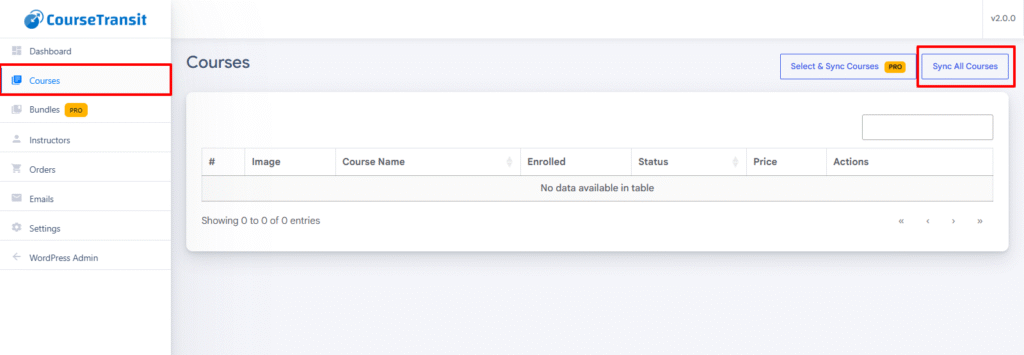
- Click Courses.
Synchronize Moodle Courses #
Use Sync All Courses to synchronize the available Moodle course catalog with WordPress. If you only need specific courses, use Select & Sync Courses ⭐ Pro.
Steps to Synchronize All Courses #
- Navigate to CourseTransit → Courses.
- Click Sync All Courses.
- Review the synchronization confirmation dialog.
- Confirm that you want to start synchronization.
- Wait for the process to finish.
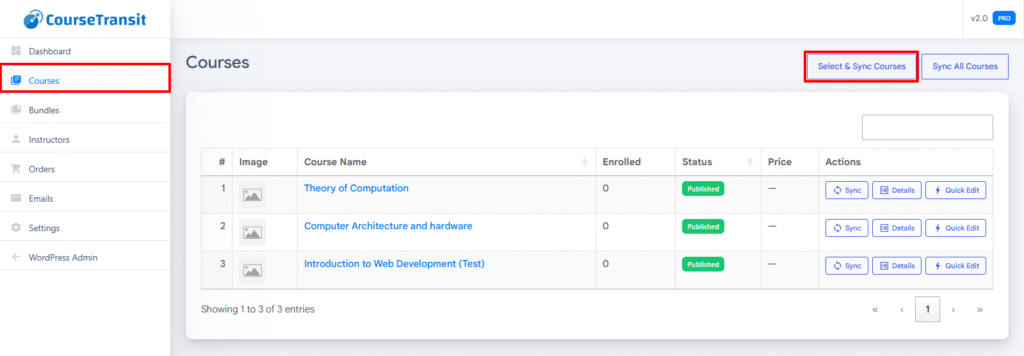
- Review the synchronized courses in the Courses table.
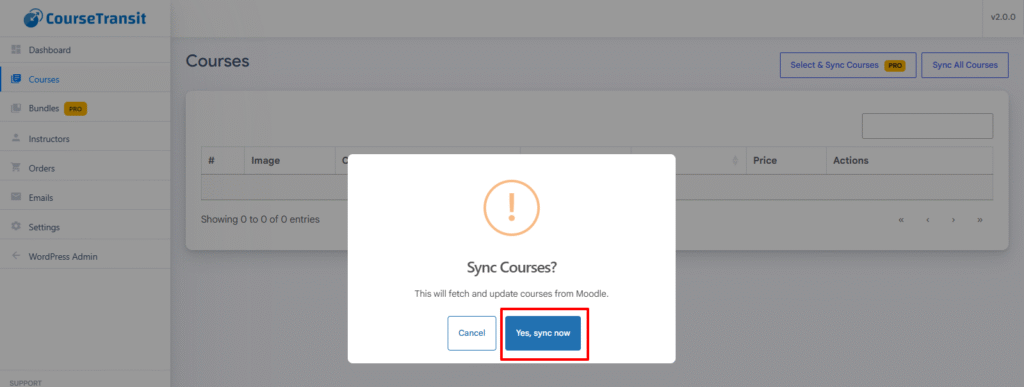
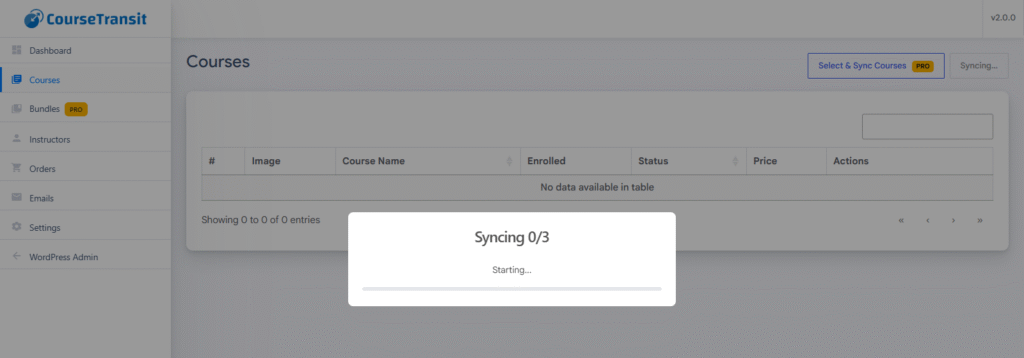
After confirmation, CourseTransit begins fetching and synchronizing Moodle courses into WordPress automatically.
- CourseTransit connects to the Moodle API
- Courses are fetched from Moodle
- WooCommerce products are created or updated
- Synchronization progress is displayed in real time
- The courses table refreshes after completion
ℹ️ ImportantDo not close or refresh the browser window while synchronization is in progress.
Synchronization time depends on:
- Total number of Moodle courses
- Server performance
- Course image sizes
- Hosting environment response time
Select & Sync Courses ⭐ Pro #
Available with a verified CourseTransit Pro license.
Select & Sync Courses allows administrators to choose which Moodle courses to import or update instead of synchronizing the entire catalog.
This is useful when managing a large Moodle installation or when only a subset of courses should be available in the WordPress store.
Steps :
- Navigate to CourseTransit → Courses.
- Click Select & Sync Courses.
- Select one or more Moodle courses from the list.
- Click Sync Selected.
- Wait for the synchronization process to complete.
- Review the imported or updated courses in the Courses table.
Benefits :
- Synchronize only the courses you need.
- Reduce unnecessary synchronization work.
- Import selected courses before making them available in the store.
- Update a smaller group of courses when required.
A valid Pro license and a working Moodle connection are required to use this feature.
Manage Synchronized Courses #
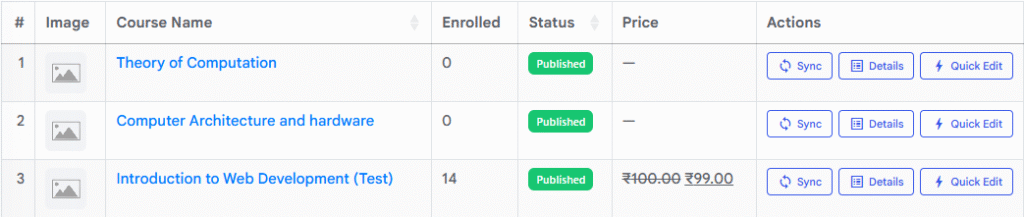
After Moodle courses are synchronized, all imported courses appear inside the CourseTransit Courses page. From here, administrators can manage synchronization, view course details, and quickly configure products.
Review Imported Courses #
All synchronized Moodle courses are displayed inside the Courses table.
Each course entry includes:
- Course image
- Course name
- Total enrolled students
- Publication status
- Product price
- Available management actions
The Courses page helps administrators monitor synchronized Moodle courses and manage WooCommerce product integration from a single location.
Synchronize an Individual Course #
Use the Sync action to update an individual course without running a full catalog synchronization.
- Navigate to CourseTransit → Courses.
- Find the course you want to update.
- Click Sync in the course’s Actions column.
- Wait for the operation to finish.
- Review the updated course information.
Individual synchronization is useful when you have changed a Moodle course and want to synchronize it with WordPress.
The exact information updated depends on the fields managed by the CourseTransit synchronization process.
View Course Details #
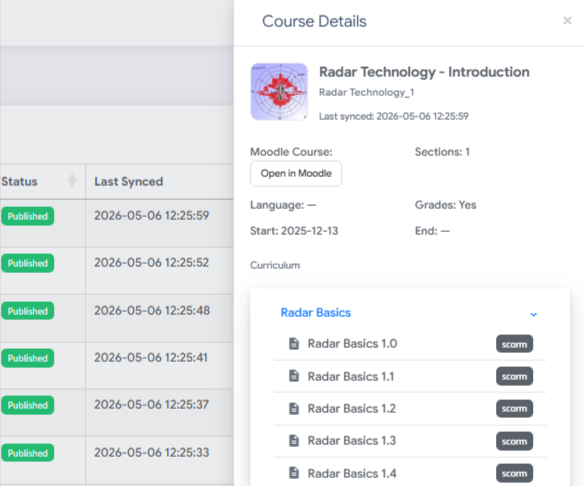
Use Details to inspect a synchronized course and its integration information.
- Locate the course in the Courses table.
- Click Details.
- Review the information in the right-side Course Details panel.
The panel can display:
- Course image, title, and short name
- Moodle course ID
- WooCommerce product status
- Enrollment count
- Number of activities and sections
- Course language
- Price and enrollment period
- Course start and end dates
- Grade support status
- Categories
- Course curriculum and activities
The curriculum area organizes available course content into sections and displays the associated activities when available.
Use Open in Moodle, when available in the course interface, to access the original course.
Quick Edit Course Settings #
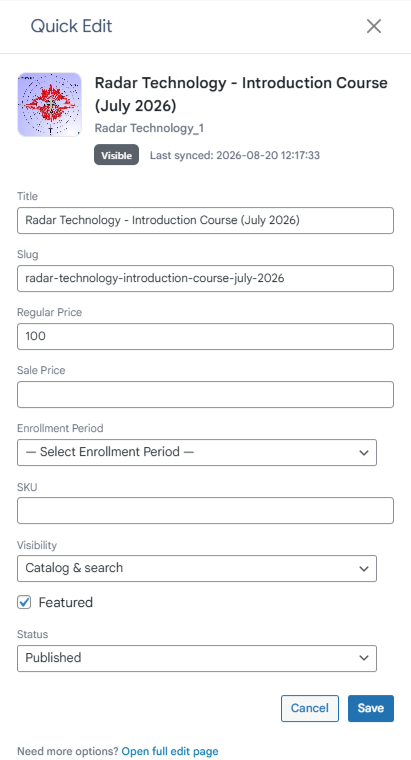
Quick Edit allows administrators to update selected WooCommerce product settings without leaving the Courses page.
- Navigate to CourseTransit → Courses.
- Locate the synchronized course.
- Click Quick Edit in the Actions column.
- Update the required fields.
- Click Save to apply the changes.
Available Settings #
| Setting | Description |
|---|---|
| Title | Change the WooCommerce product title. |
| Slug | Change the product URL slug. |
| Regular Price | Set the standard product price. |
| Sale Price | Set a discounted product price. |
| Enrollment Period | Set the course access duration. |
| Custom Enrollment Days | Enter a custom number of access days when Custom is selected. |
| SKU | Set the WooCommerce product SKU. |
| Visibility | Choose Catalog & search, Catalog only, Search only, or Hidden. |
| Featured | Mark the product as featured. |
| Status | Set the product to Published or Draft. |
Enrollment Period Options #
The available enrollment period options are:
- Lifetime Access
- 30 Days
- 60 Days
- 90 Days
- 180 Days
- 365 Days
- Custom
When Custom is selected, enter the required number of days in the Custom Enrollment Days field.
Save or Cancel Changes #
- Click Save to apply your changes.
- Click Cancel to leave the editor without saving your pending changes.
- Use Open full edit page to access the complete WooCommerce product editor for additional product settings.
For advanced WooCommerce configuration, use the Open full edit page option at the bottom of the Quick Edit panel.
Next Step #
Continue to Synchronization Settings to configure the available synchronization options for course content, curriculum, images, and categories between Moodle and WordPress.


